Labels
Jan 01, 2026
Today, I get to write a piece that has lived in my brain, my heart, and my gut for as long as I can remember.
I’ve written many versions of this to arrive here, drafts shaped by a younger me.
The one who was still learning.
Growing.
Struggling.
Trying to communicate.
Often ineffectively.
But today?
Today feels different.
Today, I write from a place of appreciation.
Of gratitude.
For the lessons I’ve been blessed to learn.
The lessons I chose to learn.
And now, lessons I am privileged to share.
So let’s begin.
Labels.
Labels.
Labels.
To me, labels are a constant and poignant reminder of the power of words.
As humans, we love labels.
They help us sort. Categorize. Simplify.
They are skills we develop early, ways to make sense of a complex world.
Labels can offer clarity.
They help us organize information.
They give us language when the picture feels overwhelming or unclear.
And when used appropriately, labels become information. Data points that help us make decisions, determine next steps, and allocate support with intention.
And yet…
What happens when labels move from helpful to harmful?
When they stop being tools and start becoming weapons.
When they turn into silos, each operating under a different manual.
When humanity gets lost somewhere between the categories.
Let me name some of the labels I’ve been sitting with:
Red v. Blue
Black v. White
Right v. Wrong
High v. Low
Neurodivergent v. Neurotypical
Gifted v. Average
Disabled v. Typically Developing
“Good” v. “Bad”
Acceptable v. Not
Accessible v. Not
Failure v. Success
Science v. Religion
Mental Health Needs v. Neurodivergent Needs
Needs v. Supports
ADHD v. Autism v. Dyslexia v. OCD v. Depression
Minority v. Majority
Tier 1 v. Tier 2
Privilege v. Poverty
Profit v. Outcome
“Behaved” v. Compliant
“Gentle” v. “Aggressive”
So I pause and wonder…
What happens when we live inside definitive labels like these?
What are we missing while we’re busy naming, sorting, defending, and dividing?
What we often miss are the observable behaviors.
The needs beneath the label.
The context.
The discernment required to look beyond ourselves and our own doorsteps.
At the root of all of this is an understanding of the brain.
Not as a buzzword.
Not as a diagnosis.
But as a living, adaptive system, shaped by experience, environment, stress, safety, and support.
Brains develop differently.
They process information differently.
They respond differently to the very same demands.
What looks like defiance may be overwhelm.
What appears to be disengagement may be protection.
What looks like capability may be masking.
When we understand the brain, we stop asking, “What’s wrong with you?”
And we start wondering, “What happened? What do you need? What support would allow you to access this moment?”
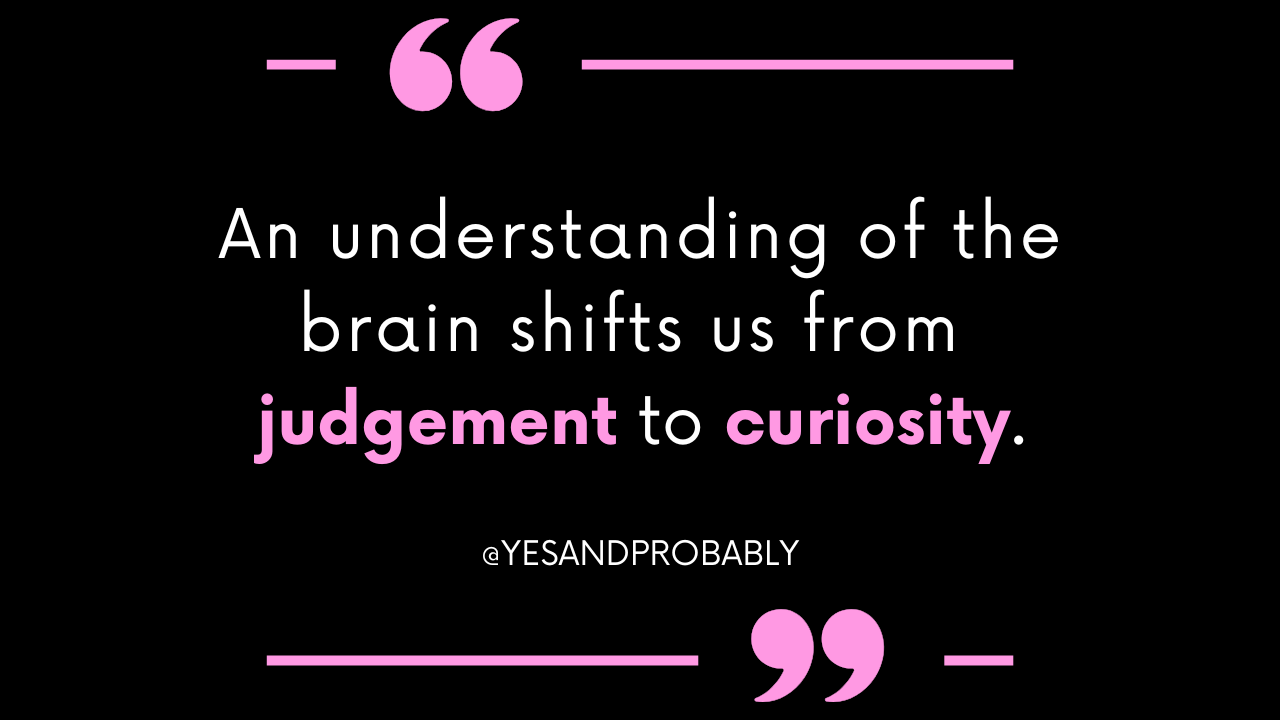
An understanding of the brain shifts us from judgment to curiosity.
From compliance to connection.
From labels as conclusions to labels as clues.
Because labels, when held well, don’t end the conversation.
They inform it.
They help us decide how to respond, without deciding who someone is.
In my lived experience, labels have often been more harmful than helpful.
I think back to my “gifted” peers growing up.
And while I carry gifted characteristics, I was never categorically labeled as “gifted.”
As a result, my observable needs were quieter.
Less urgent.
Easier to overlook.
I wasn’t neurologically diagnosed until I was 34 years old.
And I can’t help but ask myself...
What mattered more?
My label?
Or my needs?
My ability to mask like a professional.
The firstborn.
The high-achieving healer.
The one who looked “fine” on paper.
Yes, AND.
While some of my experiences with labels have been deeply challenging, there have been just as many moments when they have supported my journey.
Having language for my neurological wiring offered clarity I wouldn’t have had otherwise.
It gave me a framework.
A shared understanding.
A way to make sense of patterns that once felt personal, heavy, or isolating.
The same has been true for my children and their support teams.
When held with care, labels opened doors to collaboration.
They informed the support.
They helped adults move from assumption to understanding, from reaction to response.
The difference was never the label itself.
It was how the label was held.
Because when the majority of humans require Tier 2 support,
We have to be brave enough to re-examine Tier 1 practices.
The systems.
The structures.
The defaults we’ve normalized.
We have to slow down long enough to ask:
Who is this working for?
Who is missing?
What observable needs are being asked of us right now?
This is not a call to erase labels.
It’s a call to loosen our grip on them.
Starting points, not finish lines.
Information meant to support discernment, not replace it.
When we choose curiosity over certainty,
discernment over division,
and humanity over hierarchy…
We create space for people to be seen.
To be supported.
To be understood.
Dr. Court Bishop